Key Takeaways
- A greater lens index results in lenses that are slimmer and less heavy.
- Align your lens index with your prescription strength for improved comfort.
- Regular 1.50 lenses are effective for weaker prescriptions.
- Lenses with a high index enhance the look by lessening the thickness.
- The dimensions of the frame and the distance between the pupils also influence the final thickness of the lenses.
- Anti-reflective coatings assist in lowering glare on high-index lenses.
- High-index lenses are appropriate for nearsightedness, farsightedness, and astigmatism.
More often while purchasing eyeglasses, people pay attention to the frames for the look and comfort purpose but what about the supporting lenses? High-performing lenses ensure enhanced comfort and vision. While looking for lenses, you will come across the term lens index which is also known as the refractive index or index of refraction.
What is a lens index?
It is the number that defines the thickness or thinness of the lens. The index number is also the measurement that defines how effectively the material bends the light. The higher the index, the thinner will be the lenses. Higher the prescription, thicker will be the lens, so high-index lenses are probably the best choice for a stronger prescription as they are thin, light, and comfortable.
Generally, the index number ranges from 1.50 to 1.74 where the 1.74 index is considered to be the thinnest lens.
A clear understanding of different lens indexes:
All-inclusive frames are generally made up of standard or regular lenses of plastic material. They are known as CR 39 and have an index 1.5. Standard lenses are thicker than high-index lenses but are much affordable. If you have a low prescription, standard lenses are preferable but in the case of a strong prescription, high-index lenses are recommended. These lenses offer great comfort, make overall appearance good and most importantly the light-bending ability provides better vision. Each lens is made of different materials.
Here are the lens indexes that you should know:
1.5 Index – Standard/Regular Lenses
It’s the thickest lens that is recommended for prescription with SPH -2.5, +2.5, and below. To prevent cracking of the lenses, go for full-rimmed frames. The CR 39 lenses are conventional plastic lenses.
1.56 Index – Mid Index Thin and Light Lenses
Convenient lenses for stronger prescription, they are 15% thinner than 1.5 index. They work for prescriptions with SPH +4.00, -4.00. 1.56 index is a blend of superior optics, thin and light design.
1.57 Index – thin and light Lenses
1.57 thin and light index lenses made up of polycarbonate, other polymers, and resins are best suited for individuals with moderately strong prescriptions. Thinner and durable than standard lenses, they are highly recommended for SPN correction of +5.00, -5.00 to +4.00, -4.00, as well as CYL correction between +3.00, -3.00, and less.
1.59 Index – Polycarbonate Lenses
Polycarbonate lenses were initially used for safety glasses and now this material is actively used in making kids glasses, sports glasses, and for almost every prescription. 1.59 index offers optical clarity and also 100% UV protection. It can be fitted in rimless glasses.
1.6 High-index – Super-thin Lenses
From this number starts the high-index lenses. It’s super, almost 20% thinner than 1.5 index. It’s ideal for stronger prescriptions with SPH that range around +3.00, -3.00 to +6.00, -6.00, and above. The lenses have thinner edges with overall reduced weight. Full rim or semi rim frames are recommended.
1.67 High-index – Ultra-thin Lenses
These ultra-thin lenses are 20% thinner than polycarbonate lenses and 30% thinner than regular lenses. Higher prescriptions with SPH correction +6.25, -6.25 to +8.00, -8.00 and for CYL correction +3.25, -3.25 and +4.00, -4.00, 1.67 index lenses are highly recommended. The reduced weight and thickness make it an ideal choice.
1.74 High-index – Thinnest and Lightest Lenses
You will almost feel it’s invisible, the lenses are that thin. The stylish, lightweight high-index lenses with cosmetic benefits are suitable for strong prescription with SPH +8.25, -8.25 to +10.50, -10.50. It is aspheric in design and reduces magnification of the eyes.
1.80 High-index – Glass Lenses
It’s for the strongest prescription and only suitable for full rimmed glasses. Since plastic is recommended only till 1.74, 1.80 high index glasses are available in glass material. It’s incredibly thin which offers superior aesthetic appeal. High-index glasses have the problem of glare, so it is recommended to add an anti-reflective coating for enhanced clarity.
1.90 High-index – Thinnest Lenses Possible
It’s the thinnest high-index lens possible for the strongest prescription. It is made up of special glass material which makes the overall eyeglasses absolutely ultra-thin and ultra-light. These high-index lenses look and feel comfortable. Even they are glass lenses so they are clearly scratch resistant.
1.80 and 1.90 lens index are not easily available. However, you can easily get a lens index range from 1.5 to 1.74.
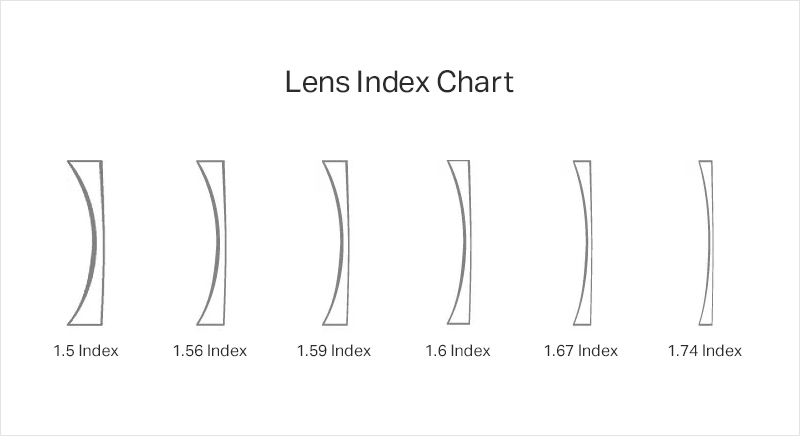
Know lens index and their specifications
| Lens index | Specification detail | SPH | CYL |
| 1.5 lens index | Standard single vision plastic lens | -/+2.25 and below | +/-2.00 and below |
| 1.56 lens index | The thin and light mid-index lenses made with polycarbonate | +4.00, -4.00 and below | -0.25 to -2 |
| 1.57 lens index | Lighter and thinner than conventional lenses | +/- 5.00 to +/- 4.00 | +/- 3.00 and less |
| 1.59 lens index | 100% UV protected Premium carbonate lenses used for safety purposes | -/+ 4.25 or above | -/+ 2.25 to -/+ 3.00 |
| 1.60 lens index | Extra thin lenses useful for strong prescription | -/+4.25 to -/+6.75 | -/+2.25 to -/+3.00 |
| 1.67 lens index | Ultra-thin lenses are an ideal choice for individuals with extremely strong prescriptions | -/+0.25 to -/+8.00 | -3.25 to +4.00 |
| 1.74 lens index | Thinnest of all lenses, they are a stylish choice for high prescription | -/+ 8.25 to -/+ 10.50 | +/- 4.25 to +/- 6.00 |
Lens thickness also depends on:
It is wise to choose the lens index according to your prescription and maintain the aesthetic appeal. However, the thickness of the lens is also determined by the size of the frames – that is frame length and breadth, frame material, and Pupillary Distance (PD). If the frame does not match your PD then it will be not as thin as you expect.
High-index lens coating:
High-index lenses come with different coatings for lenses and vision protection. The coatings include
 UV protection
 Blue light protection
 Anti-scratch
 Anti-reflective
High-index lenses are ideal for:
People with nearsightedness, farsightedness, and astigmatism might be benefited with high-index lenses. In fact, these lenses can be suitable for any prescription (particularly strong prescription) due to their enhanced performance, cosmetic appeal, and clarity.
Did you find this post helpful? Then go ahead and share it.
FAQs
In eyeglasses, what is a lens index?
How well a lens bends light is determined by its lens index. The same prescription can be delivered with a thinner lens thanks to a higher index.
Which lens index do I need to pick?
Your prescription’s strength largely determines the correct lens index. High-index options are preferable for more powerful prescriptions, while 1.50 or 1.56 lenses are often appropriate for lesser prescriptions.
Are high-index lenses superior to regular lenses?
Stronger prescriptions will find high-index lenses to be more comfortable because they are thinner and lighter than conventional lenses. For reduced prescriptions, standard lenses continue to be a cost-effective alternative.
Does vision improvement occur with high index lenses?
In a thinner form, high-index lenses offer the same prescription correction as conventional lenses. Instead of altering prescription accuracy, they improve comfort and aesthetics.
What is the purpose of an anti-reflective coating on high-index lenses?
High-index lenses are more prone to glare because they reflect more light than conventional lenses. Reflections are lessened and clarity is improved by an anti-reflective coating.
Does frame size have an impact on lens thickness?
Yes. In general, larger frames need thicker lenses, but smaller frames may help maintain thinner lenses. The ultimate thickness is also affected by frame design and pupillary distance.
Is it possible to utilize high-index lenses for any visual problem?
Yes. Astigmatism, nearsightedness, and farsightedness can all be treated with high-index lenses. They are particularly suggested for those who have higher prescriptions.
Do index lenses in 1.80 and 1.90 come in a wide variety?
No. The most popular lens indexes range from 1.50 to 1.74. 1.80 and 1.90 glass lenses, which have higher indices, are less frequent and are often reserved for extremely strong prescriptions.